Louis Lampertsdörfer of Mogada bespoke and MTM shoes, Germany
By Bernard Roetzel.
In 2025 I got in contact with German bespoke shoemaker Louis Lampertsdörfer, whose company is called Mogada. He had just won the World Championship of Bespoke Shoemakers in London and as a German I was intrigued. I rang him up to find out more.
Louis trained as an orthopaedic shoemaker in Germany. He then worked for nearly four years at Gaziano & Girling in London. In 2020 he started his own business in Munich after his return to Germany.
Initially Louis offered a big range of shoe options: ready to wear, made to order, made to measure and bespoke. That was still the situation when we first spoke, but briefly afterwards he stopped the RTW.
His MTO and MTM are both fully handmade. Louis cuts the uppers, has outworkers in France and Austria that do the closing, and his own workshop in Italy then lasts them by hand, welts by hand and sews on the soles by hand.
The bespoke is entirely made by Louis in his workshop in Munich, except for the closing (sewing the uppers together). I find shoemakers vary as to how much value they put on the closing. Certainly, it is one of the first things to be outsourced when that is possible or required.
The lasts for the bespoke are built by Louis in Munich from rough turned blocks. Bespoke costs €6000 but includes “as many fittings as necessary“ according to Louis.
He charges €2800 for MTO. This includes small changes to the RTW last to accommodate things like a high arch or added volume for the little toes. The customer can choose from a certain number of styles, a range of leathers, and options for the soles.
For MTM an extra €500 is charged, so €3300, and his standard lasts are “built up” and “adapted” according to the customer’s measurements and foot shape (in Louis’s words). It’s hard to say exactly what this includes, but it is certainly more adaptation than for MTO and involves creating a new last.

This MTM service also includes the fitting of a pair of trial shoes and is what I have tried, and will review soon.
The prices for MTM and bespoke shoes remain the same for follow-up orders even when the lasts can be used again. Louis explains that for the MTM he has to cut the uppers for subsequent orders by hand, to adapt them to the personalised lasts.
However for subsequent MTM pairs trial shoes are not necessary, unless the customer orders a different style. Loafers, lace-ups and boots each require a different type of last.
Louis holds trunk shows in Paris at Ardentes Clipei and in London at Richard Gelding. He also plans to travel to Amsterdam and Geneva but does not have the names of the shops or dates so far. In Germany he visits Maximilian Mogg in Berlin regularly.
I told Louis about my changed attitude towards the fit and functionality of shoes – mentioned in my previous article – and sketched my ideal pair of shoes.
They should be soft and comfortable enough to be worn on journeys lasting 16 hours or more. They should be good for long walks on all kinds of pavements, both on warm and dry days and when it’s wet. The soles should offer some cushioning while being smart enough to be worn in the evening with a suit.
Louis said that the majority of his customers come for very elegant shoes, handmade and ideally bespoke. But some have similar views to mine regarding fit and comfort, and he thinks that this is an important part of bespoke shoemaking in the future.
He said that he could probably make the shoes in either bespoke or MTM, but I decided to give the MTM a try because of the price difference and because it would take less time.
I had already given him a description of the functionality, feel and fit of the shoes but needed to agree on the style. I knew it had to be a lace-up and a derby shoe so we agreed on a split-toe derby with a skin-stitched apron. I found a style I liked from among his samples.

Louis started by taking the measurements of my feet. I placed my feet on a sheet of paper and the outline of my feet was traced with a pencil, first while I was standing and then sitting.
Louis also traced the silhouette of the feet from the side to determine their height. Then my feet were measured with a tape measure. Afterwards an imprint of my feet was also taken. This is particularly useful to show the condition of the arch.
Louis said that my feet are not a great challenge for a shoemaker because they are not flat, not extremely bulky, and the arch is not very high. The little toes need a bit more space but that is easy to solve, in his opinion.
From the measurements Louis determined that I should try size 8 for my left foot and 8.5 for the right. He gave me try-on shoes in these sizes.

Louis paid special attention to the fit at the heel and around the arch. My feet are pretty narrow in that area. I tried both sizes on both feet and Louis watched me walking around. We both agreed that the two different sizes worked well for the two feet.
I asked Louis why he doesn’t use RTW lasts in different widths as the basis for the MTM. His answer was: “I prefer to adapt the lasts individually. A customer who has feet that are wide in the front doesn’t necessarily have a wide heel. If I use a wide fitting for the foot it is a good basis for the front, but too wide at the heel. I’d rather use a standard width and build it up where it is necessary.“
I asked Louis if it makes much difference for the customer if the lasts are completely bespoke or based on the RTW lasts. He answered that he can make perfectly fitting shoes with MTM for 90% of customers. Only 10% have feet that really need bespoke.
He showed me pictures of a bespoke last he was working on. The last was literally banana shaped when looked at from above. It would be impossible to adapt a RTW last to this shape, but a bespoke last can do that when you starting from rough blocks.

Louis suggested to add a bit of arch support to the insoles to make the shoes more comfortable.
We then finalised the style. Louis had brought some samples of the split-toe derby that I liked and they looked good. I then asked about the heels. I had had one pair of loafers made in the past without discussing the heels, and I was horrified when I saw the finished shoes – the heel was high and angled, reminding me of a flamenco dancer’s shoes.
If heels are too high (or too low) they cannot be changed later because the whole shoe would be thrown out of balance.
Louis showed me the height of the heels that he suggested and this was settled.
As the penultimate step we looked at leathers. Louis prefers to decide on the leather after the style is chosen because not every type of leather works with every style. We remained with my initial wish for black and he showed my a couple of different options for softer leathers.
I think black leather must have a bit of texture to make it interesting (like dark suits and white shirts). Black suede is out of the question for me, but I immediately liked an antique pigskin that he had.
Louis was okay with the pigskin even though it is rather thin. For the lining he recommended vegetable-tanned calf with no finish. It is free of chrome salts and offers maximum absorption of moisture, which is important in the warmer season and when travelling.

We finally looked at different examples of toe caps and I picked a square one. I think a square shape follows the natural alignment of my toes and I also prefer the look to a pointed toe cap. I told Louis that I would like the shoe to not be (or to look) too elongated.
He had wanted to show me samples of rubber soles, but he forgot to bring them. So he sent me photos of two options later, and I picked the thicker one. Both offered a good amount of protection and cushioning. As Louis put it: “You don’t feel every little piece of gravel through these soles.”
This first meeting was before the summer. We then had a first fitting in the first half of September, which I will describe in detail when I cover the finished shoes. Before Louis started cutting, an issue with pigskin leather occurred. You will read how this was resolved in the next piece.
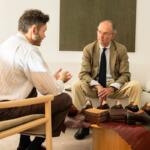
Clothes pictured on Bernhard:
- Self-lined RTW jacket made of Jägerleinen (traditional linen/cotton weave from Austria) from Marc Anthony in Hamburg
- Bespoke linen shirt made by Gino Venturini in Vienna
- Unlined tie from Jay Kos in New York
- Vintage lightweight wool/poly RTW trousers from Gardeur
- Bespoke crocodile belt with sterling silver buckle from Bernd Kreis
- Vintage Moreschi loafers
- Silk pochette from Hussars Madrid