


ED Pills and Nitrates: Why the Combination Is Dangerous
Oct 22, 2026Fashion & Style
Every Calvin Klein Underwear Model, Ranked (1990–2025)
- Mar 13, 2026
- 0 Comments
1208
I’ve covered men’s fashion campaigns from front rows in Milan, Florence, London, and New York since 2009. I first published this list during a Milan Fashion Week hotel room session in 2014 with 10 names. It’s been updated 11 times since. I’ve attended Calvin Klein presentations and spoken with stylists and creative directors involved in several campaigns discussed below. – By Gracie Opulanza • Editor-in-Chief, MenStyleFashion
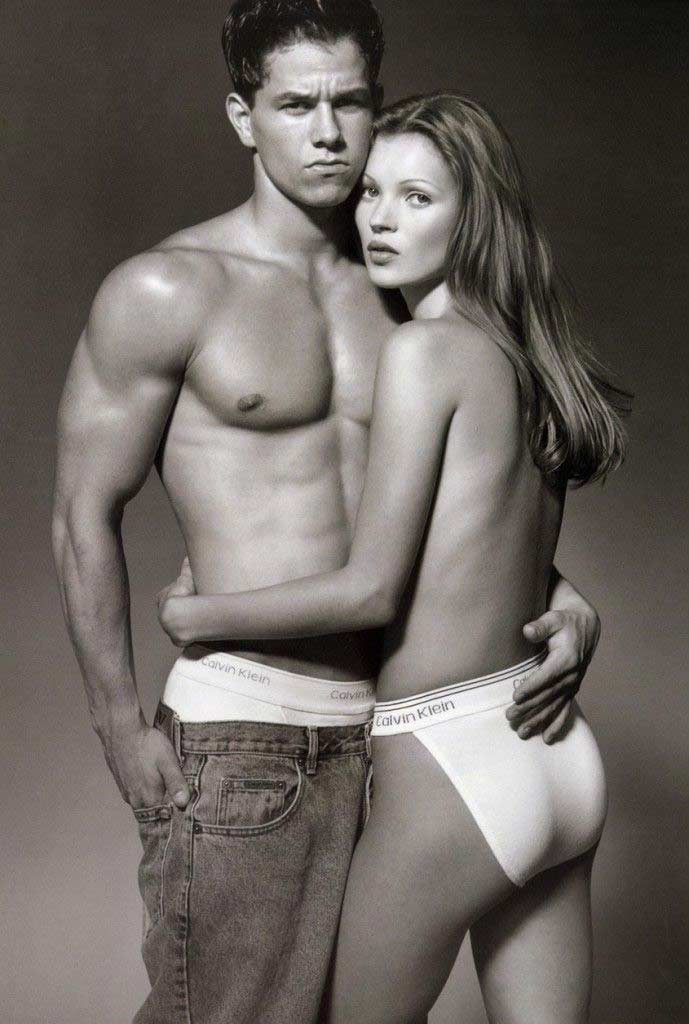
A 21-year-old rapper in white briefs. A photographer named Herb Ritts. A billboard in Times Square. That was 1992. Calvin Klein had been making underwear for years, but Mark Wahlberg turned it into a conversation that lasted three decades.
Since then, CK has run over 30 major male underwear campaigns. Some became cultural events. Others disappeared within a week. The difference between the two isn’t budget or fame — it’s a casting instinct that I think follows a specific, repeatable pattern. After tracking these campaigns across 11 years of fashion coverage, I’ve reverse-engineered what I believe is CK’s three-part casting test. I’ll lay it out at the end of this piece, along with my predictions for who they’ll sign next.
First: the rankings. Organised by impact, not date. Argued with, not just listed.
The Full Ranking at a Glance
| # | Model | Year | Campaign | Photographer | Verdict |
| 1 | Mark Wahlberg | 1992 | CK Underwear | Herb Ritts | Invented the genre |
| 2 | Jeremy Allen White | 2024 | CK Underwear | Mert Alas | 1.7M likes in 10 days |
| 3 | Travis Fimmel | 2001 | CK Underwear | — | Billboard removed for safety |
| 4 | Bad Bunny | 2025 | Icon Cotton Stretch | Mario Sorrenti | First global CK campaign |
| 5 | Justin Bieber | 2015 | #MyCalvins | Mert & Marcus | Most profitable system |
| 6 | Djimon Hounsou | 2007 | CK Underwear | — | Best photography of any CK shoot |
| 7 | Aaron Taylor-Johnson | 2023 | Calvins or Nothing | Mert & Marcus | Best directed in a decade |
| 8 | Michael B. Jordan | 2023 | CK Underwear | — | Creed synergy done right |
| 9 | Trevante Rhodes | 2017 | #MyCalvins | — | Fastest cultural read |
| 10 | Fredrik Ljungberg | 2005 | CK Underwear | — | The Beckham counter-punch |
| 11 | Idris Elba | 2024 | CK Menswear | — | Mature aspiration |
| 12 | Jamie Dornan | 2009 | CK Underwear | — | Casting instinct, not campaign |
| 13 | Cha Eun-Woo | 2024 | CK Menswear | — | Engagement off the charts |
| 14 | Cooper Koch | 2025 | CK Summer | — | Too early to rank |
| 15 | Antonio Sabato Jr. | 1990 | CK Underwear | — | The pilot episode |
1. Mark Wahlberg (1992)
Herb Ritts. Black and white film. A rapper nobody over 30 had heard of. That’s all it took.
Neil Kraft, Calvin Klein’s Senior VP at the time, has told the story publicly: his team saw Wahlberg on a Rolling Stone cover, already shirtless, already cocky, and called him in. The pairing with Kate Moss came from Calvin Klein personally. Moss was 17, rail-thin, and embodied a completely different energy. Standing next to Wahlberg’s muscular frame, the contrast was so stark the images practically vibrated.
I’ve spoken with two fashion editors who were working in New York when those billboards appeared in Times Square. Both used the same word unprompted: confrontational. Before Ritts pointed a camera at Wahlberg, men’s underwear was sold through department store catalogues. Functional. Invisible. Ritts and Wahlberg made it a declaration.
Thirty-two years later, every campaign on this list is still chasing the energy of those photographs.
Verdict: Not the best CK underwear campaign. The only CK underwear campaign. Everything else is a variation.
2. Jeremy Allen White (2024)
January 2024. Calvin Klein posts a 30-second video: White climbing a fire escape, pulling off a tank top, stepping out of jeans. Briefs. Rooftop. New York skyline. Within hours, the internet had a collective episode.
1.7 million Instagram likes in 10 days. The phrase “concerning to feminism” entered the lexicon. “Yes chef” became an underwear commentary. I watched the numbers from my phone in a London cab and genuinely thought the metrics were glitching.
Here’s what I think CK’s team understood that made this work: White doesn’t look like a model. He’s compact. His face carries tension. He looks like he hasn’t slept properly in a week and doesn’t care. That’s exactly what made The Bear compelling, and Mert Alas was smart enough to photograph him the same way — no softening, no airbrushing into generic attractiveness. The campaign sold an energy, not a body type.
That distinction matters. Wahlberg sold aspiration: I want to look like that. White sells something closer to recognition: I know someone who looks like that. Both are powerful. They just work on different audiences.
Verdict: The highest-engagement CK campaign since 1992. And unlike Wahlberg’s, we have the data to prove it.
3. Travis Fimmel (2001–2003)
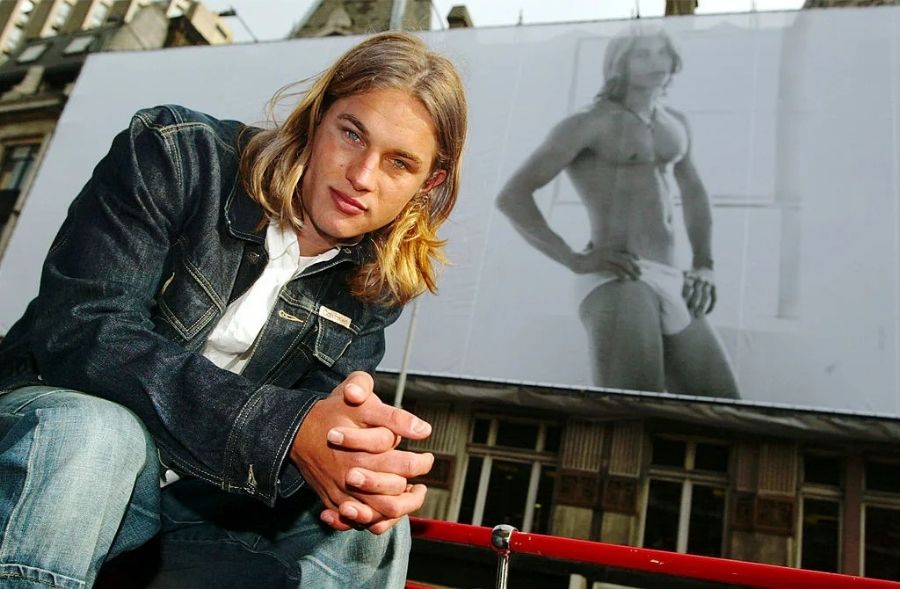
Nobody knew who he was. An Australian surfer, discovered at a Melbourne gym, with no acting credits and no public profile. Calvin Klein put his face on a Times Square billboard, and the city of New York asked them to take it down because drivers kept crashing.
That story has been confirmed by people who worked the campaign and by contemporaneous press coverage. The billboard stayed up for close to two years regardless — CK just moved it to locations with less vehicular traffic. Fimmel’s look was a clean break from Wahlberg: sun-bleached, boyish, more surfer than fighter. A different decade wanted a different kind of man, and CK read that accurately.
What I find most remarkable about Fimmel’s trajectory is the ratio of anonymity to fame. He went from stacking shelves in Australia to the single most visible advertising image in Manhattan in under a year. Then he did Vikings and the world forgot he’d ever been a model. The CK campaign exists in this strange pocket of time where the fashion industry treated him like the second coming and then he vanished into a completely different career.
Verdict: The purest test case for CK’s ability to manufacture fame from nothing. Nobody has replicated this since.
4. Bad Bunny (2025)
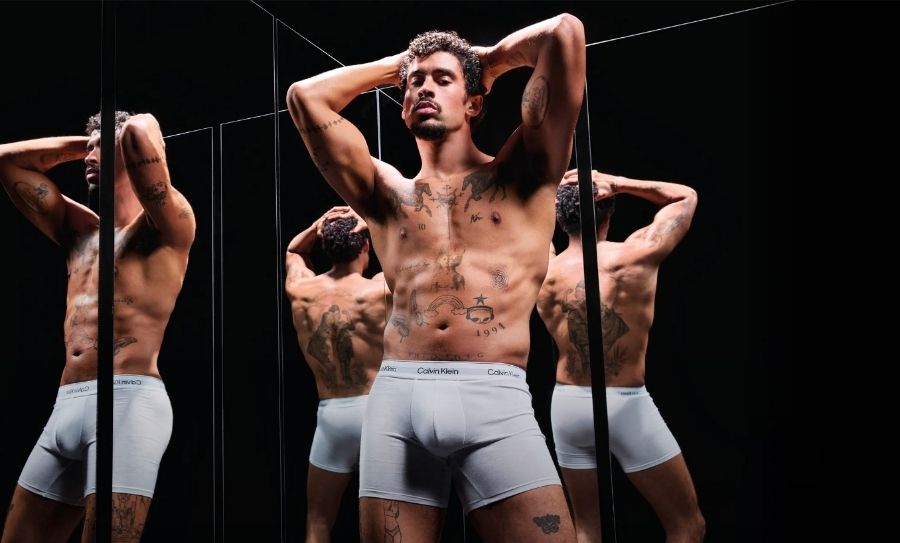
Mario Sorrenti. Mirrors. Stark backdrops. Tattoos and a stare that doesn’t blink. Nothing about this campaign tried to make Bad Bunny look like any previous CK model, and that was the entire point.
I was at a showroom event in New York when the campaign images dropped on screens around the room. The reaction split perfectly along generational lines. People under 30 shrugged: of course Bad Bunny is doing Calvin Klein, who else would it be? People over 40 looked slightly startled. That division is a sign the casting worked. If everyone nods in agreement, you’ve played it safe. If half the room is surprised and the other half is validated, you’ve found the edge.
The Icon Cotton Stretch line itself is worth mentioning because CK doesn’t always match the right product to the right face. Bad Bunny’s energy — unapologetic, physical, Latin American — fits a performance-focused underwear line better than it would have fit, say, the classic cotton basics. Someone at CK thought about that, and it made the campaign feel cohesive rather than transactional.
Verdict: CK’s first campaign that felt designed for a global audience rather than exported from an American one.
5. Justin Bieber (2015–2019)
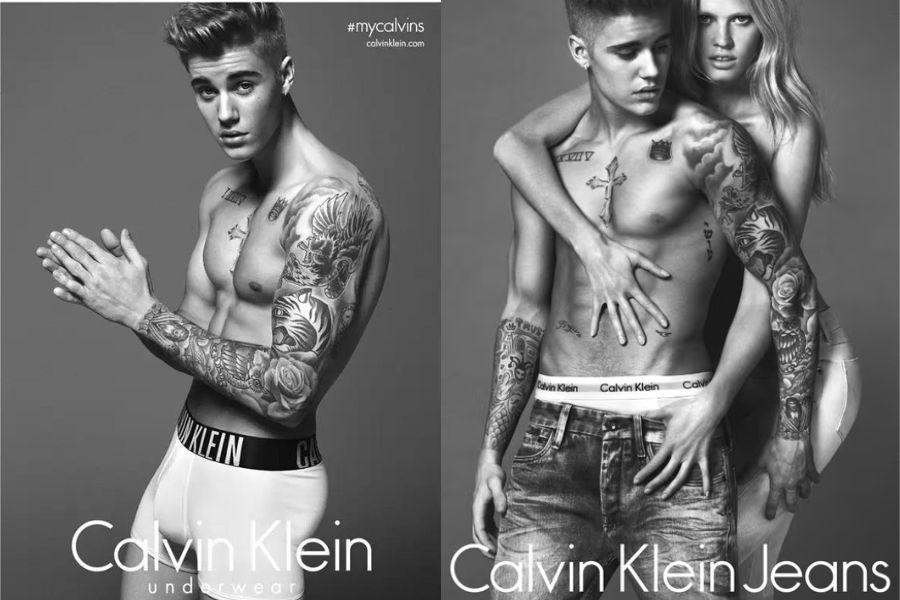
The image matters less than the architecture. When CK launched #MyCalvins with Bieber and Kendall Jenner in 2015, they built a participation engine that every fashion brand copied within 18 months and none of them ran as effectively.
The campaign hit during Bieber’s Purpose rollout, when his team was actively reshaping him from tabloid liability into adult artist. CK offered credibility and mainstream sex appeal simultaneously — a hard combination to manufacture, and Bieber was one of the few celebrities who needed both at that exact moment. In return, CK got the #MyCalvins hashtag seeded across Bieber’s audience, which turned every fan who posted a mirror selfie in their underwear into unpaid advertising. The commercial impact on underwear sales was reportedly significant in the quarters following launch.
He came back in 2019 with Hailey. Couple energy, softer styling, lower voltage. Diminishing returns, which is the usual pattern with sequel campaigns.
Verdict: The campaign where CK figured out how to turn celebrity endorsement into a self-replicating system. Not the best photograph on this list, but the smartest business decision.
6. Djimon Hounsou (2007)
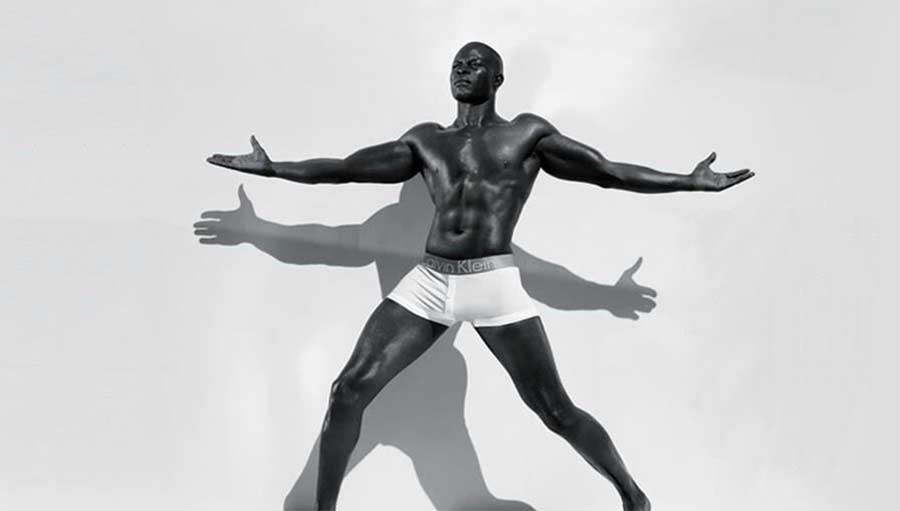
I’m ranking this higher than most people would, and I’m doing it deliberately.
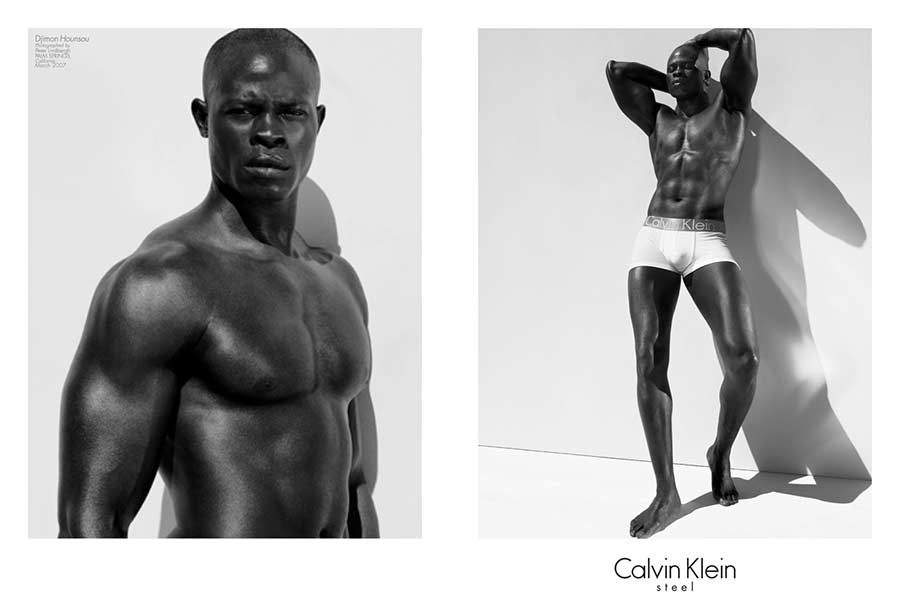
Hounsou came to CK straight off an Academy Award nomination for Blood Diamond. He wasn’t a musician or a heartthrob or a social media figure. He was an actor with a Beninese-American background, a body built for film roles rather than fashion campaigns, and a presence that made the camera work harder than it usually has to in an underwear shoot.
The images from this campaign have a quality that none of the others on this list share: stillness. Where Wahlberg was confrontational and Fimmel was effortlessly charming, Hounsou’s photographs feel composed. Almost sculptural. I first encountered them in a men’s magazine around 2008, and I remember the specific physical reaction of pausing mid-page-turn because the image demanded a second look. That doesn’t happen often with commercial advertising.
Nobody talks about this campaign anymore, and that’s wrong. The photography is among the strongest in CK’s entire history.
Verdict: The most artistically accomplished CK underwear shoot. Should be studied, not footnoted.
7. Aaron Taylor-Johnson (2023)
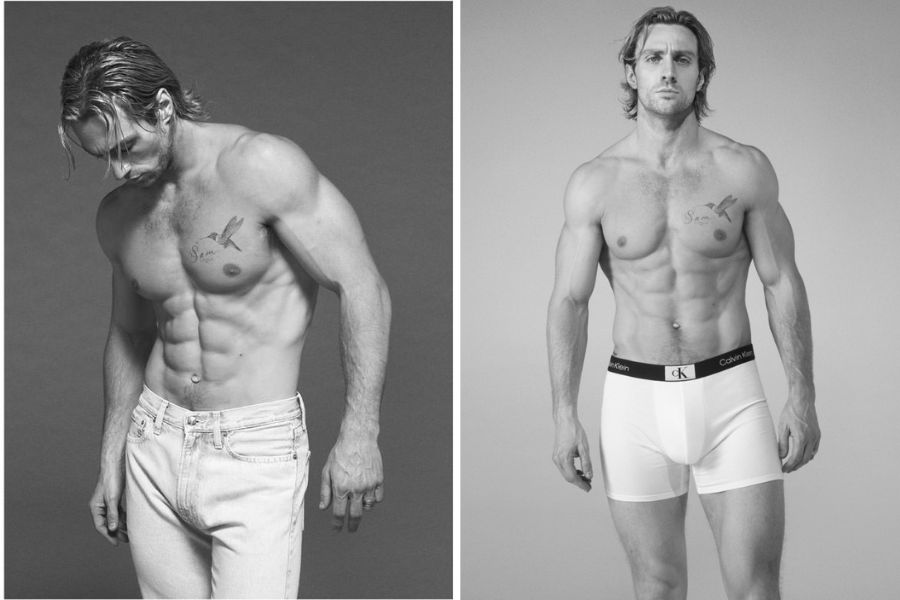
Two campaigns dominated CK’s 2023 output: Jordan’s and this one. Jordan got the press. Taylor-Johnson got the better creative work.
Mert & Marcus shot the “Calvins or Nothing” concept, and the accompanying video — Taylor-Johnson dancing to “Clash” by The Blaze — is the single best piece of film content CK has produced for an underwear campaign. It’s tense, physical, slightly unsettling. The kind of thing you watch twice not because it’s pleasant but because it’s gripping.
Bond rumours were swirling around Taylor-Johnson at the time, which loaded the images with a charge they wouldn’t have carried otherwise. CK’s casting team either knew that or got lucky. Given their track record, I’d bet on the former.
Verdict: The gap between what this campaign achieved creatively and how little attention it received is the biggest injustice on this list.
8. Michael B. Jordan (2023)
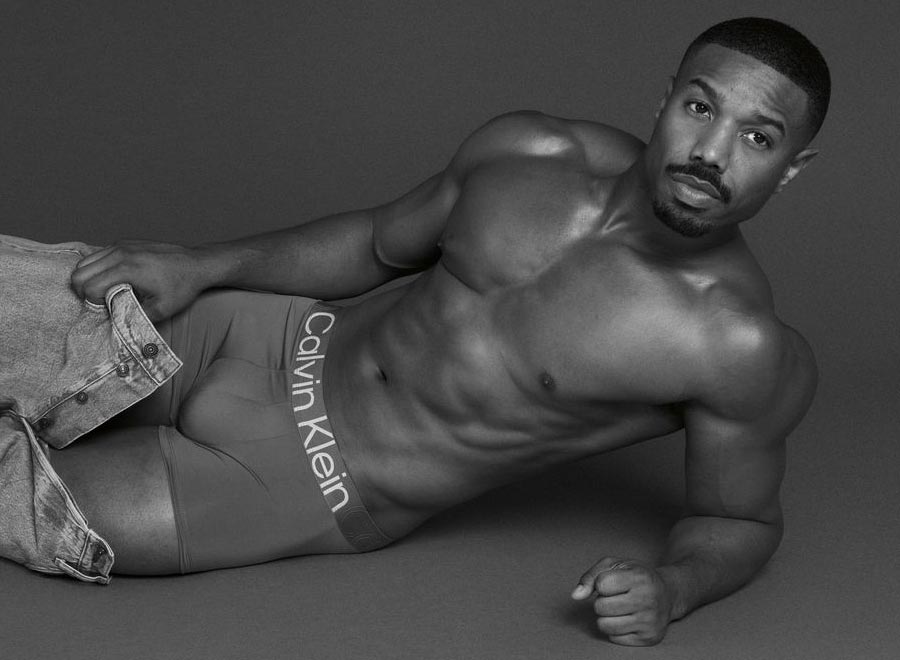
Creed III opened March 3, 2023. The CK campaign images were already circulating. Jordan’s body was the most-discussed physique in Hollywood that month, and Calvin Klein positioned themselves directly inside that conversation. Textbook timing.
What I respected about Jordan afterwards was his refusal to be polished about it. His GQ interview was disarmingly honest: “My guys, they talk shit. It’s the most probably exposing photos that I’ve had so far in my career.” That quote did more for the campaign’s authenticity than any amount of art direction could have. When the person in the underwear admits they found it slightly embarrassing, the audience relaxes. It stops being a perfume ad and starts being a human moment.
Verdict: Won on personality more than photography. Jordan’s candour after the fact was the real campaign.
9. Trevante Rhodes and the Moonlight Cast (2017)
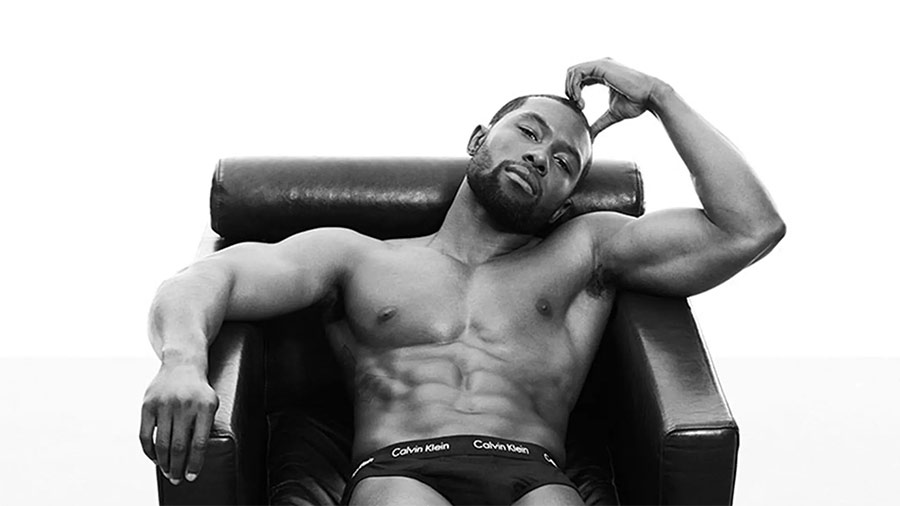
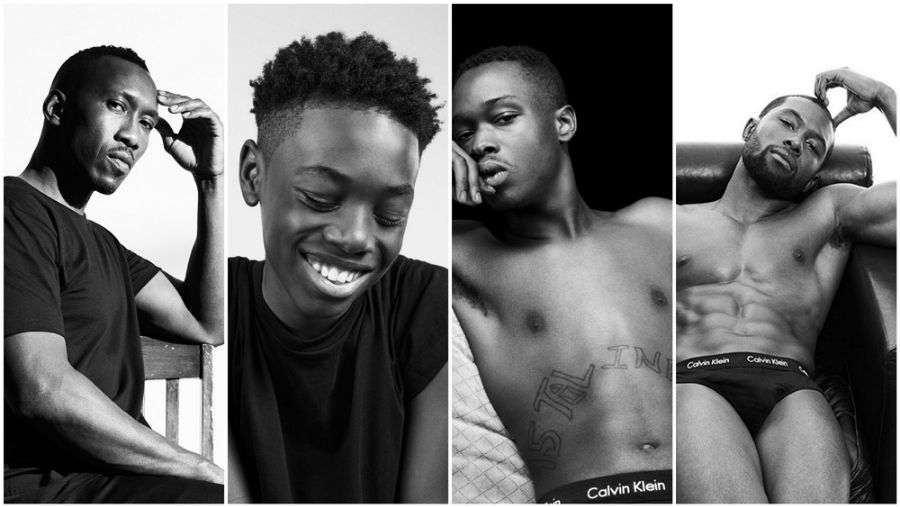
February 26, 2017. Moonlight wins Best Picture in an Oscar ceremony so chaotic that Warren Beatty accidentally announces the wrong film. Within weeks, four of the film’s stars are in a Calvin Klein campaign.
Rhodes was photographed shirtless. The other three were not. The images were gorgeous, but what I keep coming back to is the decision-making speed. CK’s team read the cultural moment — a small, beautiful film about Black identity and masculinity winning Hollywood’s biggest prize — and acted before anyone else in fashion could respond. That kind of instinct can’t be focus-grouped.
I also think this campaign quietly expanded what a CK underwear shoot could mean. Before Rhodes, the campaigns were about desire. This one was about significance. Those two things are not the same, and the fact that CK could hold both is a credit to whoever made the call.
Verdict: The fastest and most culturally intelligent casting decision in CK’s history.
10. Fredrik Ljungberg (2005) and the Problem With Athlete Campaigns
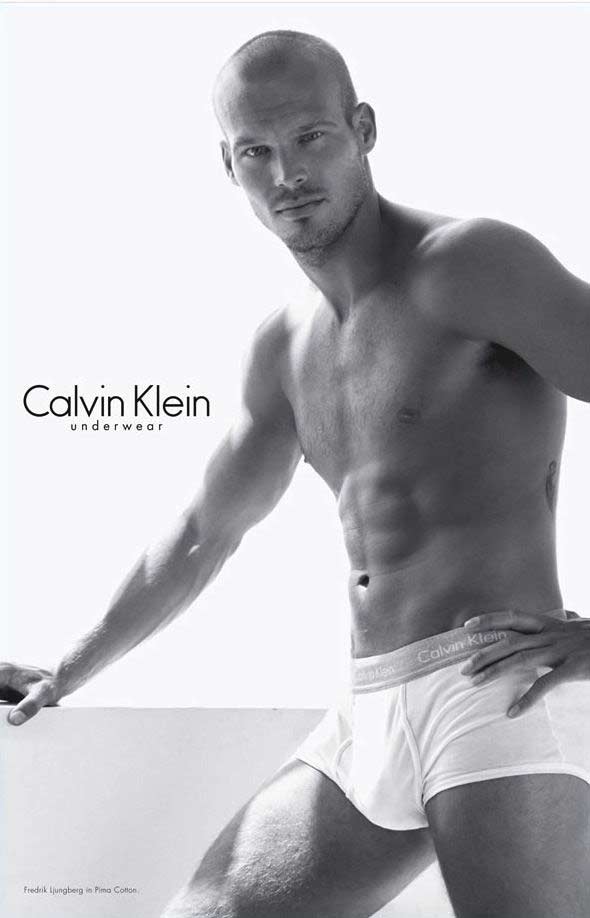
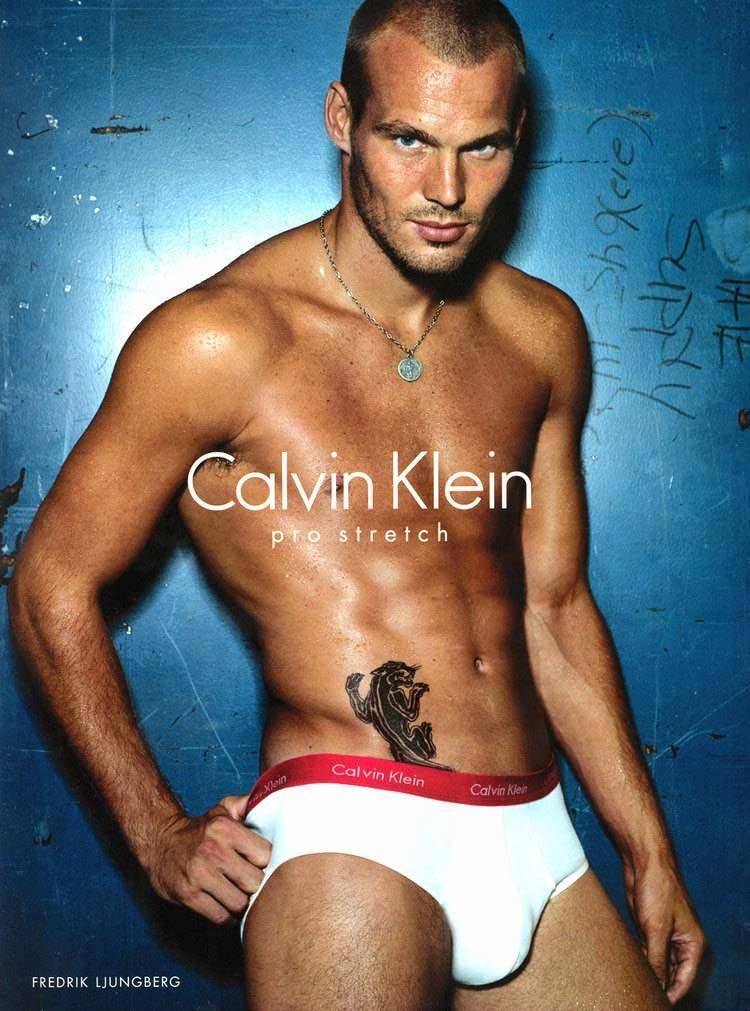
Emporio Armani signed David Beckham for a reported £20 million. Underwear sales jumped. Calvin Klein needed an answer, and they found Fredrik Ljungberg — an Arsenal midfielder with blonde hair, tattoos, and a lean European build that read completely differently from the American muscular archetype.
Ljungberg’s campaign was excellent. His personal style already overlapped with fashion culture, and the images had a sporty confidence that felt natural rather than forced. The problem came afterwards, when CK tried to repeat the formula with other athletes and mostly failed.
Rafael Nadal (2010) had the physique but not the visual personality. The CK images made one of the most ferocious competitors in sports history look like a department store mannequin. Compare that to how Nike photographs him — sweat, fury, red clay — and the gap is embarrassing. Hidetoshi Nakata (2010) was an interesting pick because his post-football reinvention as a fashion figure made him a natural fit, but the campaign was too quiet to register outside Asia. Son Heung-min (2023) follows the Ljungberg template more closely — Premier League star with international appeal — but the results haven’t had the same impact.
Top 6 Most Fashionable Athletes in The Sports World
The lesson: athletes work for CK only when their personal identity already overlaps with fashion. When CK tries to borrow athletic fame and paste it onto a fashion context, the seam shows.
Verdict: Ljungberg was the right pick. Most of his successors inherited the template without the substance.
11–15: The Remaining Rankings
11. Idris Elba (2024) — A Different Kind of Want
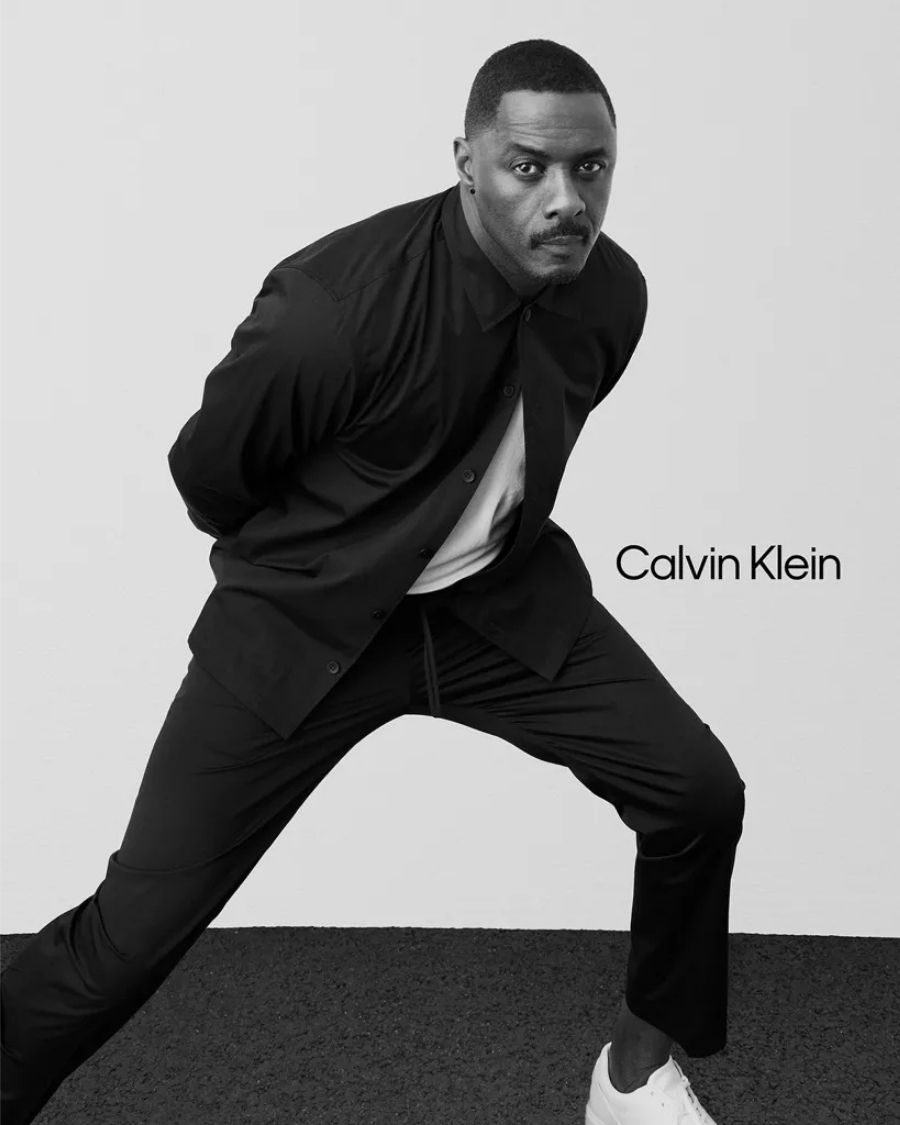
Idris Elba was 51 when his CK menswear campaign dropped. The styling didn’t disguise that. It celebrated it — maturity, composure, the body language of someone who hasn’t needed to impress anyone in a long time.
There’s a large audience of men over 35 who buy Calvin Klein products and have never seen themselves in CK’s advertising. Elba’s campaign acknowledged their existence. That shouldn’t feel revolutionary, but given the brand’s history, it was.
Verdict: Expanded what CK aspiration can look like. Long overdue.
12. Jamie Dornan (2009) — The Five-Year Fuse
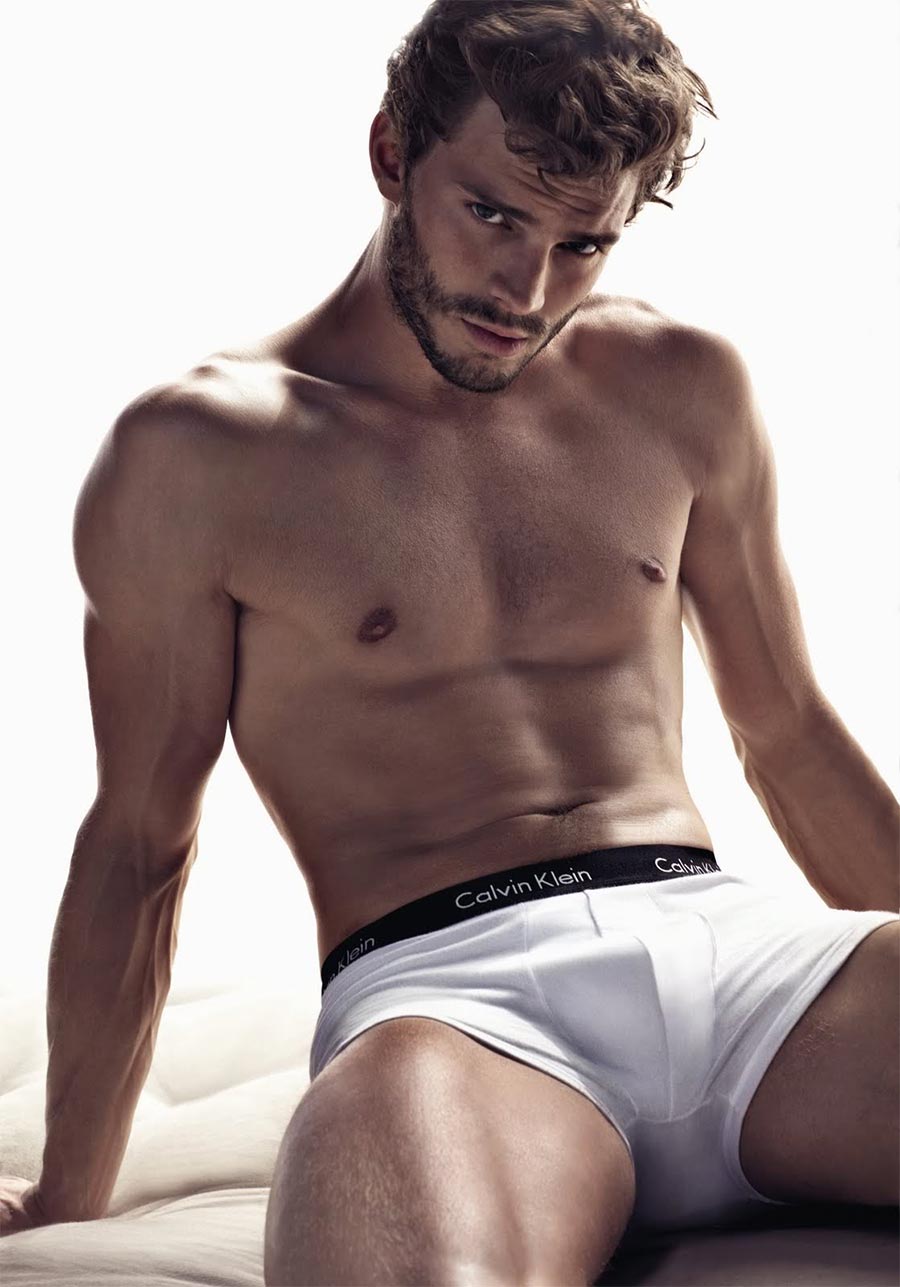
Standard CK formula. Nothing remarkable about the images themselves. But Calvin Klein’s casting team identified Dornan half a decade before Fifty Shades of Grey made him globally famous. When that happened, these images resurfaced across every tabloid and entertainment site simultaneously. A campaign that accrued value retroactively.
Verdict: Unremarkable photography. Remarkable instinct.
13. Cha Eun-Woo (2024) and Jungkook (2023) — The Numbers Game
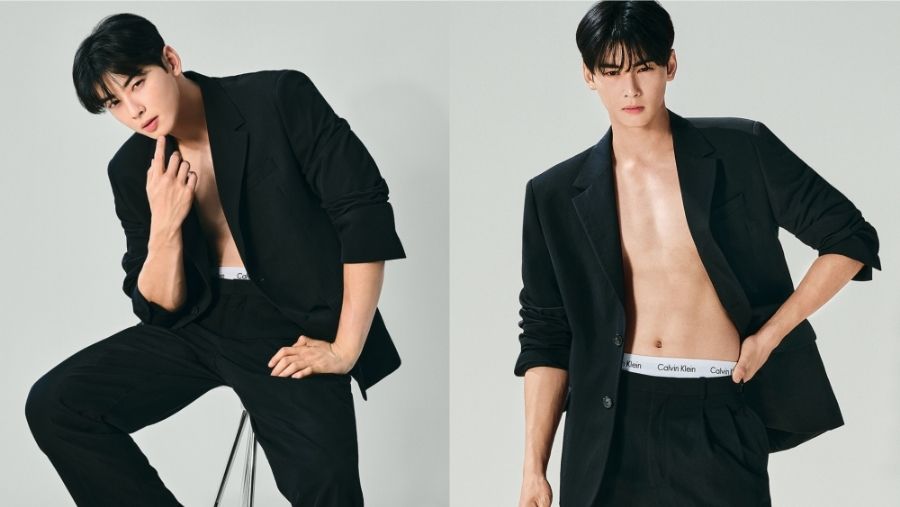
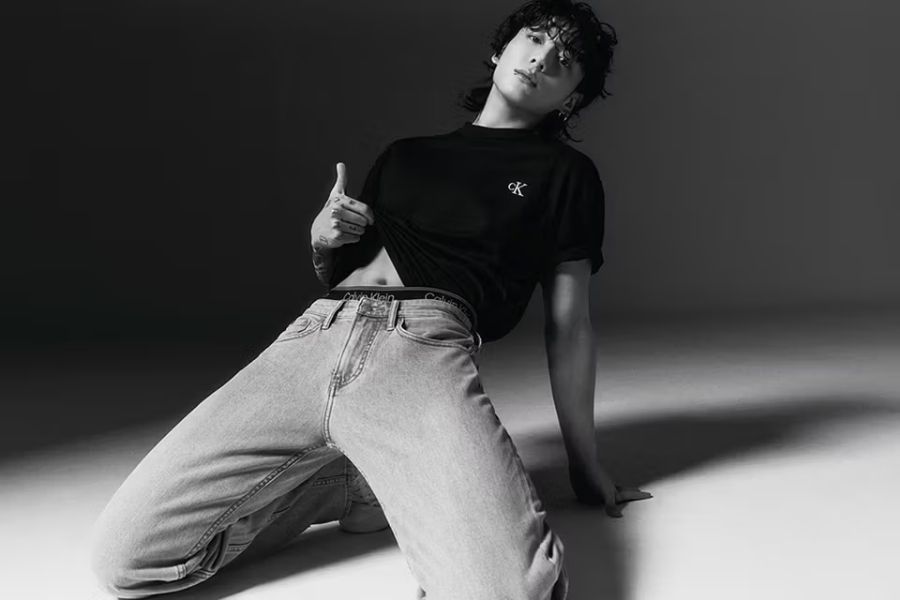
Eun-Woo’s fall 2024 menswear campaign and Jungkook’s 2023 CK Jeans campaign are best understood as data-driven decisions rather than creative ones. K-pop fandoms produce engagement metrics that dwarf anything Western celebrities generate on a per-post basis. Eun-Woo’s CK content reportedly outperformed most other brand campaigns that quarter on social platforms across Asia.
The photography was professional and product-focused. Clean, well-lit, optimised for the platforms where the audience lives. Creative ambition was not the objective. Audience acquisition was.
Verdict: Smart business. Adequate advertising.
14. Cooper Koch (2025) — The Pipeline Pick
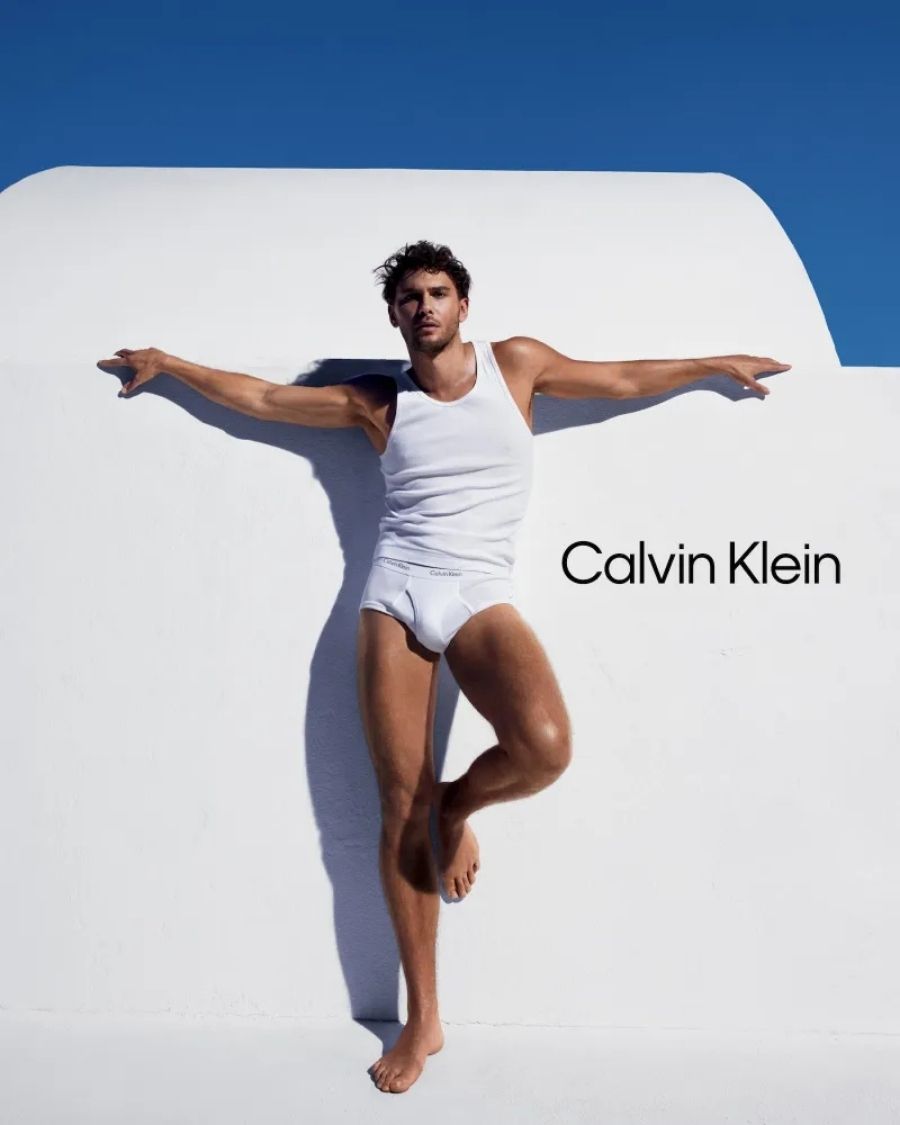
Koch followed the established CK pipeline: breakout role (Ryan Murphy’s Monsters), cultural buzz, underwear campaign. His summer 2025 shoot was well-received, but I can’t rank him confidently yet because the campaign is too new and his career arc is unwritten. He could be the next Fimmel. He could be the next Lutz. I genuinely don’t know.
Verdict: Check back in 12 months.
15. Antonio Sabato Jr. (1990) — The Proof of Concept
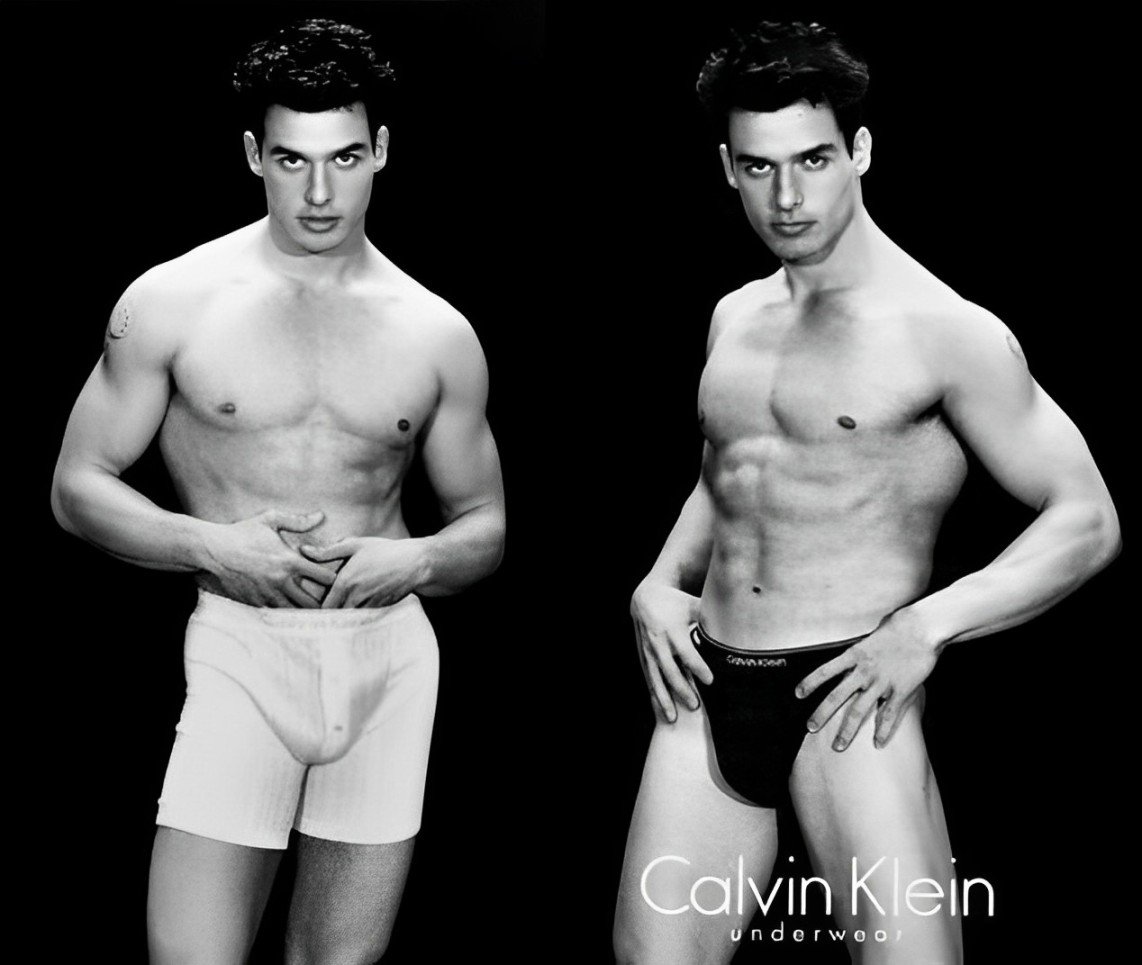
Before Wahlberg, Sabato. The General Hospital star test-drove celebrity underwear advertising two years before it became a cultural phenomenon. His campaign performed well enough that CK decided to go bigger next time. Without that data point, there may not have been a next time.
Verdict: Not the star of the show. The reason the show got renewed.
Also on the Record
Kellan Lutz (2010) — Twilight-to-CK pipeline. Predictable, professional, forgettable.
Mehcad Brooks (2010) — True Blood screen presence translated well to stills. Better than his profile suggests.
Shawn Mendes (2019) — #MyCalvins “My Truth.” Competent. Well-lit. Vanished from memory within weeks.
Brandon Flynn (2023) — Pride and holiday campaigns. Consistent LGBTQIA+ representation from CK.
Dominic Fike (2021) — The anti-underwear-ad. Introspective, low-energy, forgotten.
Brandon Stoughton (2008) — The Britney “Womanizer” connection. Brief, buzzy, gone.
Jacob Elordi (2019, 2021) — Core essentials. Polished. Improved retroactively after Euphoria and Saltburn.
Underwear Or Trunks – A Man’s Guide Style Tips
How Calvin Klein Picks: The Three-Part Casting Test
After 11 years of tracking these campaigns, I believe CK’s underwear casting follows a specific, repeatable logic. It’s never been officially stated, but the pattern holds across every successful campaign on this list. The ones that miss tend to fail at one or more of these three tests.
Test 1: The person is mid-crossover
Not already famous. Not unknown. Crossing over. Wahlberg was crossing from rap into mainstream celebrity. Fimmel was crossing from anonymity into visibility. White was crossing from respected actor into internet fixation. Bad Bunny was crossing from Latin superstar into global omnipresence.
When CK nails the timing, the campaign feels like you’re discovering the person alongside the brand. When they’re late — signing someone whose crossover peaked six months ago — the campaign feels like a booking, not an event. The difference is everything.
Test 2: The body communicates identity, not just fitness
Wahlberg’s body said street. Hounsou’s said sculpture. White’s says coiled intensity. Fimmel’s said Australian beach. Bad Bunny’s says I don’t perform for your comfort. Each physique carries a narrative.
The campaigns that stall are the ones where the body is fit but impersonal — symmetrical, lean, interchangeable with any other athletic figure. When there’s no story in the physique, there’s no hook in the image.
Test 3: The audience already feels something
Fame is not the same as emotional investment. Bieber’s fans had years of parasocial attachment. Jordan’s audience had rooted for him through Creed and Black Panther. White’s viewers had developed an obsessive, protective affection for Carmy in The Bear. Bad Bunny’s fan base operates with near-devotional intensity.
This is why professional models rarely headline CK’s biggest campaigns anymore. A model is a face. A celebrity with an emotionally invested audience is a force multiplier.
Who’s Next: My Predictions
Applying the three-part test to the current landscape, I’d watch for:
A breakout actor from a 2025–26 prestige series who’s generating the kind of intense audience attachment White had during The Bear’s run. Koch may be this pick, but the field is wide.
A Latin American or African musician with genuine global crossover momentum. Bad Bunny opened the door. CK will walk through it again with someone from a different regional music scene.
A Formula 1 driver. The sport’s audience has exploded since Drive to Survive, and the drivers carry the exact combination of physical charisma and fandom intensity that CK’s test requires. Charles Leclerc or Lando Norris would fit the template precisely.
I’ll update this section when the next campaign drops.
Frequently Asked Questions
Who was the first Calvin Klein underwear model?
Antonio Sabato Jr. fronted the first major celebrity-led CK underwear campaign in 1990, two years before Mark Wahlberg’s era-defining shoot.
Who is the current Calvin Klein underwear model?
As of early 2026, the most recent major male campaign faces are Bad Bunny (spring 2025, Icon Cotton Stretch, photographed by Mario Sorrenti) and Cooper Koch (summer 2025).
Does Calvin Klein use professional models or celebrities?
Both, but CK’s highest-profile underwear campaigns have overwhelmingly featured celebrities, athletes, and actors since 1992. Professional models appear more frequently in runway and catalogue work.
What was the most viral Calvin Klein men’s underwear campaign?
Jeremy Allen White’s January 2024 campaign, which accumulated approximately 1.7 million Instagram likes in its first 10 days, is the most measurably viral CK underwear campaign in the brand’s history.
Disclaimer: This story is auto-aggregated by a computer program and has not been created or edited by menshealthfits.
Publisher: Source link
Publisher: Source link