




ED Pills and Nitrates: Why the Combination Is Dangerous
Oct 22, 2026Fashion & Style
The Best Merino Wool T-Shirts Tested: Wool vs. Synthetic vs. Cotton
- Feb 16, 2026
- 0 Comments
332
We independently evaluate all recommended products and services. Any products or services put forward appear in no particular order. if you click on links we provide, we may receive compensation.
The Setup
Uniqlo synthetic t-shirt after 15 miles of running. Smell test. Take one. Ooh.
This is a cotton t-shirt. I’m pretty sure you’re familiar with it, although this one does have a cool graphic on the back.
This is Patagonia’s pride and joy. Patagonia first discovered this fabric. I think it was on football jerseys or soccer jerseys, and now it’s one of their flagship fabrics. This one is covered in mint oils so you don’t smell bad.
And this is a 100% merino wool t-shirt. It dries incredibly fast, faster than cotton. It is soft like silk. It doesn’t wrinkle. It never stinks even when synthetics do. It’s the perfect t-shirt. There are absolutely no drawbacks. Is that what I wrote? It doesn’t seem like something that I would write. It does. It’s okay. It does have some drawbacks.
If you Google merino t-shirts, you will see horror stories of people saying it’s not worth the hype. Their shirts are full of holes. The process to make these shirts is incredibly toxic and worse than synthetics. It’s worse for the environment.
And of course, the final one, it’s not even real wool being used. It’s just plastic.
So the real question of today’s article is how good are merino t-shirts actually? How do they stack up to synthetic t-shirts? How do they stack up to cotton t-shirts? We’re going to do a few tests to see, do they smell more? Are they stronger? Are they weaker? The drying time?
And then overall thoughts. And we’ll see. There’s some stuff where merino absolutely destroyed and some stuff where it got destroyed and then there’s the big controversial thing at the end.
Test #1: The Smell Test
Patagonia Capilene Cool Daily
The first t-shirt up was Patagonia’s Capilene Cool Daily T-shirt. This t-shirt destinks by being covered in mint oil. The mint oil binds to the odor molecules so that way they don’t drift off and enter into your nose. No offense to Patagonia.
They did not do a whole lot of binding. I haven’t worn synthetics in a very long time. So I kind of thought, well, surely technology has gone far enough where one to two days of running or high activity will make you not stink. Not true. This kind of ruined my experiment right off the bat. I wanted to wear each t-shirt for three days and I did, but I stunk on the first day.
Uniqlo Synthetic
Then I kind of immediately broke the rules of testing and I added another contender to the list because Patagonia uses mint technology. So I was curious what would happen if I got a brand of t-shirt that didn’t use mint technology because there’s a lot of other different ways to make something anti-stink.
So I got this Uniqlo t-shirt and initially I was a lot more happy with it, especially on my run. Although we can’t confirm for sure because Uniqlo doesn’t really give a lot of information about their products. I’m assuming it’s using silver, the metal, which Lululemon also uses, but they wrap the actual polyester filaments in silver. This actually smells far worse than Patagonia did. So I don’t know what tech Uniqlo is using, but not as good.
The Testing Graph
Hello everyone. Welcome to our little graph. This is to keep track of how everything is performing. So on the left is performance, one being the worst, 10 being the best.
On the bottom is what we’re testing: synthetic, cotton, and wool. And then on the right is our key because we’re testing smell, drying speed, strength. So this graph will populate as we go through all of the tests.
Why Synthetic Clothing Smells
All right. So now, if we understand why synthetic clothing smells, then everything kind of opens up and you think, what if we did it the other way? And that’s what we’re jumping into. But synthetic clothing, one either doesn’t absorb any liquid at all, that’s polyester, or it’s nylon, and it absorbs like 1 to 2% of liquid, basically nothing.
So all of your warm, cozy sweat for bacteria sits on top of your clothing. And then at the same time, synthetics love to hold on to all of the gross stuff that is coming out with your sweat, like proteins and fats and stuff like that. So it basically just holds a little petri dish under your arms or wherever you’re sweating a lot and lets the bacteria grow and eat and love it. And it’s very hospitable to bacteria over time so the smell doesn’t go away.
Cotton Performance
Oh, poor cotton.
It always gets dunked on when you’re looking at performance fabrics and wool and synthetics. It’s always like this and this and this and then cotton sucks. What is cool about cotton is when you think about what it’s for, then it makes total sense. It is a seed dispersal system. It has to protect the seed at all costs.
And when you wrap it up and make it into a fabric, guess what, buddy? You become the seed. And cotton’s going to try and save your life the only way it knows how, which is actually very ineffective for saving a human’s life. Cotton sucks in every single drop of water that it can get its hands on.
And while it’s sucking all that up, it is also sucking up the gross stuff from your sweat. And on top of that, it is not holding on to all of the oils and gross stuff anyway in your sweat. Once it dries off, a lot of it will just evaporate out. So cotton is more anti-stink than synthetics.
And after 3 days, it smelt a little bit, but I feel like cotton for the most part, it felt like the oiliest, the grossest. It didn’t really hold the structure at all, but it smelt less. Overall, definitely a strong second place. I would have probably washed it on day two. Realistically, I’d only go running in it once, but the smell wasn’t unbearable.
The Wool Fiber Breakdown
Now, what’s very interesting about cotton and synthetics is they’re basically both the same thing. So cotton is basically cellulose throughout. It’s one thing and it looks like a ribbon. It’s very pretty. There’s not a lot going on. Synthetics, there’s, I think, probably even less going on. It’s incredibly uniform throughout. It’s just very long strands of polymers, but there’s not a lot of variation going on on the fiber level. Wool, on the other hand, gets its own heavenly montage breakdown of the fiber.
First time I saw that, I thought, “Wow, someone paid a lot of money for that.” But if you look at this versus a little cellulose ribbon and a straight plastic string, you probably think it’s going to perform differently, and it does.
This is the section where there’s going to be some drama and some people are going to get angry. So I’m going to explain something, but I will amend it later on. But all that is to say, I have done some truly disgusting things while wearing wool. Wool socks, wool t-shirts. I have worn wool longer consistently than you would ever feel comfortable with. I promise you that. Socks. Have I ever changed my… Well, I have changed my socks, but I don’t change them that often, and they smell fine.
The Pinecone Demonstration
I want to find something to show you as a demo. Okay, so pretend this pine cone is a single sheep’s wool fiber. Single as in one, not as in a sheep that’s not dating someone. All of these little ridges on the fiber are scales that you also have on your hair. This way, nice and smooth. This way, grabby, and it keeps stopping my finger. Each one of those scales on the wool fiber shaft is layered.
So there’s different layers on each scale. And there are two to three layers of scales on top of the shaft. These are very very important. This is called the F layer. The F layer is incredibly hydrophobic for a few reasons. The big huge one is that usually wool shafts, wool fibers are covered in lanolin, which is a waxy greasy substance that you have probably rubbed on your face at one point in time if you like skincare products or swallowed if you take certain types of vitamins.
But the scales themselves, ignoring that waxy substance from the sheep, are also hydrophobic in layers on the scale. And if we go inside of the fiber, this would not look like this. This would basically be a circle like this that’s split into two sections. The orthocortex and the paracortex, I believe, basically the center, and that is where water does go in and does get absorbed but it’s water vapor. So the chemical makeup of wool combined with the fact that it absorbs water vapor and repels some water on top makes it this monster of anti-stink.
Smell Test Results
And wool is truly the gold standard of anti-stink. Cotton was so much better than synthetics for the smell test because it could suck up so much water and it wasn’t super hospitable for bacteria to grow and everything like that and it didn’t bond to the stinky stuff that much. Wool is that on steroids.
So wool just absolutely destroys everybody. Perfect bar graph chart, 10 out of 10. Great. It is the gold standard in anti-stink. That is its strongest attribute. And then we start to go a little bit the other way but not as much the other way as I initially thought.
Test #2: Drying Speed
Drying speed was actually a lot more complex than I initially thought. I thought this would be in-and-out, synthetic dominates. Not totally the case. But take it away, testing Michael, please.
The Shrink Test
What’s up, everybody? Welcome to the shrink test segment of today’s piece. Can you see that, though? Look at that. It’s fall. It’s my first real fall in Portland. And didn’t notice that there was an apple tree right above our heads when it wasn’t dropping apples. I went apple picking right before I did this test. 36 apples so far. Three dozen.
I ended up doing this test three different times. The first time I just threw everything in the laundry machine to make sure that it was equally moist. The second time I thought synthetic was going to dominate. So I kept that in the water last and the third time I tried to even everything out.
But each time I noticed the same thing again and again and again and that is that wool and synthetic seemed pretty close which surprised me. So I did more research. Also, sorry to cotton, buddy. You tried your absolute best, but we’re aiming to dry faster. So cotton is still soaking wet in the bag. It’s disqualified. It took like… it’s still not dry. So over 12 hours.
Research Results
A lot of people have done a similar test. Well, people actually did better tests. So luckily, there is better data than what I have, but I thought synthetics would crush wool, but wool actually felt drier. And that led me down the path of doing a lot more research to be like, what the heck is going on? I don’t want to say something stupid in this article.
And I found two other, well, three other tests. One from Backpacking Light, which found, as we would expect, synthetics dried faster, but not that much faster than wool. And more interestingly, which was also backed up by another guy, is that the time for both synthetics and wool to dry is actually pretty similar. And they lose water at the same amount of time. Just wool holds on to a little bit more because it absorbs around 30% of water vapor.
So, really, all that is to say, yes, synthetics dry faster, but they don’t destroy wool in the way that I thought they would. But it is important to note that since water doesn’t absorb in, I think if you’re running or you’re really agitating the synthetic shirt, it will dry even faster. But still, it’s not this giant gap like you see with cotton and synthetics or something like that.
Test #3: Durability and Strength
Okay, now we are knee-deep in the section where people will retract their reviews. They’ll initially love their shirt, then they’ll hate it. They’ll say they’re giving up on wool. All of this stuff. That would be durability. I have a cool graph you should look at.
Well, Holly made it, but still cool. I didn’t make this data up obviously. I got it from Woolmark, but it’s very interesting. The bottom you’ll see running along there is how stretchy is the fabric and then the top is how strong is the fabric until you can snap it or break it or something like that.
The Durability Graph
So cool graph and immediately we could see why people like the $5, $8 cotton t-shirts cuz they’re pretty darn durable for what they are. That’s pretty good. And then we can look at polyester and synthetics and you can see yeah those are a lot more durable. Not that stretchy on the polyester end, but of course you can make a synthetic that is still pretty strong and still pretty stretchy.
That’s a pretty good graph. And cotton still kind of competes. Then we have wool. Wool very stretchy, not super super strong when you’re pulling on it. It’s also very bendy. It can bend a lot without breaking. But this is the reason that merino wool t-shirts break down faster than cotton or something like that. Just not as strong.
Real-World Experience
As far as my own evidence goes, I’ve had a bunch of Proof 72-hour merino t-shirts, which are I think 13% nylon for like 4 years now, and they were washed and dried on hot by Brooklyn Laundromat.
And this is the only one. I had three. This is the only one with holes in it. And personally, I feel like four years without caring about wash instructions and actually doing the worst possible thing you can to them and only having one have holes in them, I’m pretty happy with that. It is a blend, though. So we do have some nylon there.
I also, there’s a guy online that has had a Wool & Prince shirt that he wore every day for 4 years straight and he doesn’t have a hole in it. So I’d be pretty happy with that. But those are both blends with Unbound or REI has some or Outlier anything like that where they’re 100% merino wool.
Obviously you can expect durability to go down and to be honest I’m wearing 100% wool right now. I like this shirt a lot but I am going to ignore the care instructions completely and do what Taylor does.
Taylor’s Method
Taylor loves her Unbound Merino, her wool sets and stuff like that. She hand washes everything gently and then she’ll hang it dry, but she’ll do it horizontally, so she’s not stretching anything.
Her stuff looks great and she wears it almost every single day and she wears a pajama set every single day and has been for like four or five months. Looks perfect. Looks like the day she got it, but she treats it incredibly carefully.
The Controversy: Superwashing
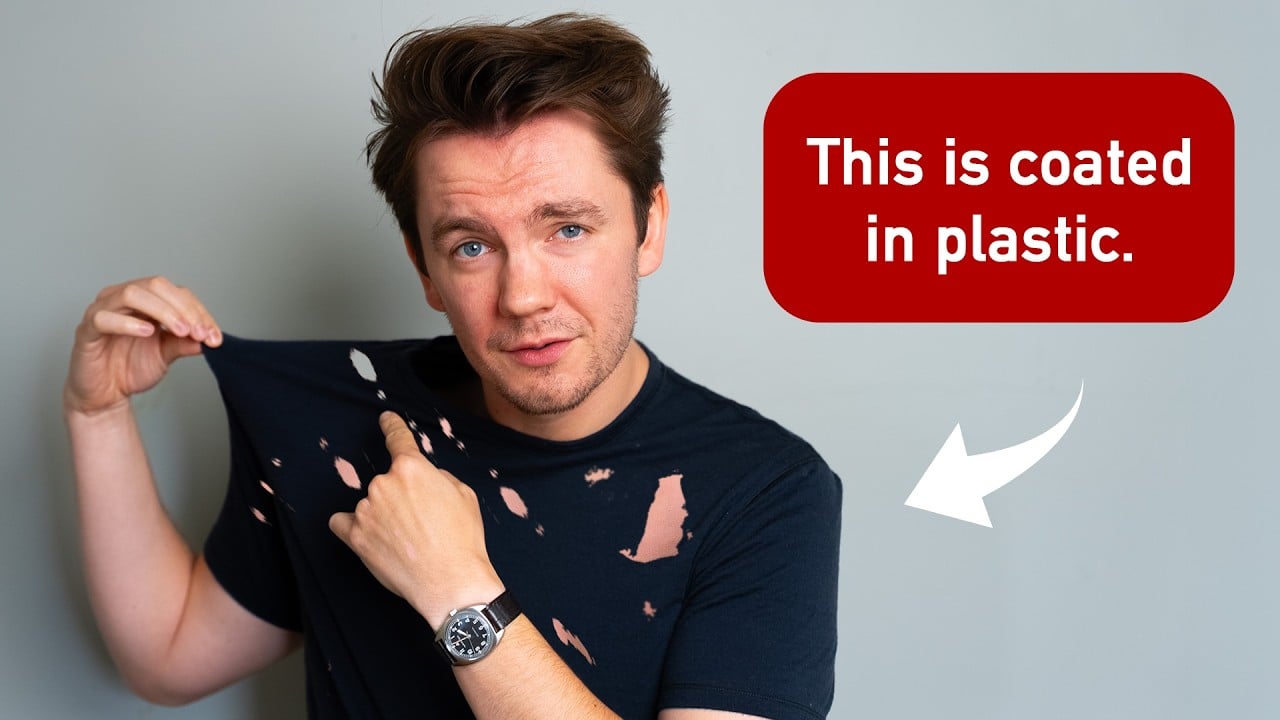
Superwashing is wool covered in plastic. This is the most controversial wool thing that you could do to wool. So I called Unbound Merino to try and get more clarity and I spoke to Hala who helped me out.
What Is Superwashing?
Hala, what the heck is superwashing? Superwashing in itself is basically applying a chlorinated substance or water to the surface of untreated wool to dull the scales of wool. Wool, as you know, has scales. When multiple fibers are coming in contact with each other, those scales can lock together and felt the wool and then your wool shrinks a ton and it’s hard to wear everything like that.
That’s not good.
If you want an easy to care for shirt that a lot of people that don’t know anything about wool buy, so you have to fix that. Something that’s important to note before that that we will then harp on in a little bit is that lanolin, that lanolin coating, the stuff you put on your face, usually that’s washed off of wool no matter what, whether it’s superwashed or not. That’s virtually all but gone on most wools.
The Superwashing Process
Either way, back to pine cone time. Hello. Welcome to Pine Cone. Felting, sticking together, that’s a big problem. Also makes a shirt less comfortable to wear against your skin for a lot of people that are sensitive to wool. So what do you do? You put this wool fiber in a chlorine solution and you burn the tip of all of these scales off. You dull all of these.
So these don’t have a problem anymore. They just slip past each other because you fill in what you burned off with a polymer, with a resin. That resin, that coating is insanely popular. It is on most likely your paper towels, your tea bags, your napkins, anything that’s papery that is going to get wet and needs to hold its shape, probably covered in this resin called Hercosett. Very popular. Future the rapper wrote a whole song about it.
The Environmental Concerns
Now, you can probably assume any technology that was made in the ’50s was developed in the ’40s. And you know what else was also developed in the ’40s? The atom bomb. So if this didn’t work, they’re probably just going to say, “What do you think would happen if we hit wool with a nuke?” But they didn’t.
They just took a bunch of Hercosett and had a great time. You can assume there wasn’t a whole lot of environmental safety standards in the 1950s. So for a very long time and still today at less environmentally conscious manufacturers and stuff like that and facilities, that’s bad. Chlorine solution and stuff is not safe for the workers. It’s really really bad for the environment. It’s no good. So that was the first thing I asked Hala and Unbound Merino before we even partnered up. What the heck is actually going on at your facilities? And this is what Hala said:
“We do it in a closed loop process so that the chlorination gets converted into a more sustainable carbon that gets separated from the water before it gets into natural environment and then additional substances that come out or waste get also moved into a more sustainable process that get used into like byproducts of other industries and so on. So it’s the least amount of waste that goes there.”
The Plastic Debate
So now you can kind of see where people might be like, “Well, it’s not really just wool. It’s plastic or it’s this or that.” But then we hit the snare, the big snare of everything when we’re trying to pick out our favorite fabric from this list.
Usually you’ll find superwashing information mixed in with the fact that wool is a more resource intensive fabric to make than synthetics, than polyester. So it just looks worse and worse for wool. But when you zoom out, it’s different.
New Technologies
One thing is that there’s a ton of new superwashing technologies out there that are getting more popular right now. Usually a different superwashing technology like you can plasma treat wool. Typically that’s just more expensive so less people would buy it.
So in turn it’s less popular and there’s also other ways to do it that weaken the wool to a point of not being able to use it. But point of that is you’re still reducing the amount of plastic in your shirt by factors. It is a huge amount. This is barely any plastic versus something that is 100% plastic. And even if you get a blend, that’s still 80% less plastic, which is kind of cool.
The Big Picture: Environmental Trade-offs
And now the big snare is that Patagonia uses mint instead of silver salts because they found that when you would wash clothing, the silver and stuff would come off and go into the ocean and then affect marine life over time. So they switched to mint, but the problem is it’s not completely getting rid of your smell.
And Patagonia says the only way to do that is to wash your clothes every single time you use them. But then they kind of get snared in their own thing and say, “But just don’t forget that that is also the second biggest energy usage user of the lifespan of your clothing next to it being made.” So it’s a big fat snag because they’re saying, “Wash your clothing every single time you wear it.” And then a brand like Wool & Prince is saying, “Hey, we’ll give you an award if you don’t wash your shirt for 100 days of wear straight.”
Watch This Article
Final Recommendations
So this is usually where people just devolve into name-calling and being mean to each other on the internet when they’re debating whether wool or synthetics are better.
So my personal opinion, if you can be like Taylor, you definitely should get wool. That is hand washing. You don’t wash it really at all, only when you really, really need to, and you’re not lugging backpacks and heavy things and, you know, kind of abrading the wool a lot, you’ll love wool.
If you’re a step down from that and you might be a little bit more harsh on your clothes, but you still don’t want to stink, you want all the cool properties, totally get a blend.
On the other hand, if you’re going to go rucking, if you’re going to wash your shirt every single day, no matter what, cuz you just think that’s gross, whatever you’re going to do with wool is yucky, why would I do that? Then get synthetic.
And then if you just want a casual shirt, you’ll probably like cotton the most. Bye!
The Iron Snail is a men’s fashion vlog (and now article series!) starring a young man named Michael and featuring a snail no bigger than a quarter. The two are set on taking over the world of fashion by creating a clothing line to end all clothing lines. Until then, we’re here to tell you EVERYTHING you need to know about the best clothing out there, from the highest quality raw denim jeans to the warmest jackets to the sturdiest boots…the Iron Snail has got you covered.
Disclaimer: This story is auto-aggregated by a computer program and has not been created or edited by menshealthfits.
Publisher: Source link
Publisher: Source link